Austin

Austin is a Python frame stack sampler for CPython written in pure C. Samples are collected by reading the CPython interpreter virtual memory space to retrieve information about the currently running threads along with the stack of the frames that are being executed. Hence, one can use Austin to easily make powerful statistical profilers that have minimal impact on the target application and that don't require any instrumentation.
The key features of Austin are:
- Zero instrumentation;
- Minimal impact;
- Fast and lightweight;
- Time and memory profiling;
- Built-in support for multi-process applications (e.g.
mod_wsgi). - Support for agentic workflows, with an MCP server and a query API for coding agents.
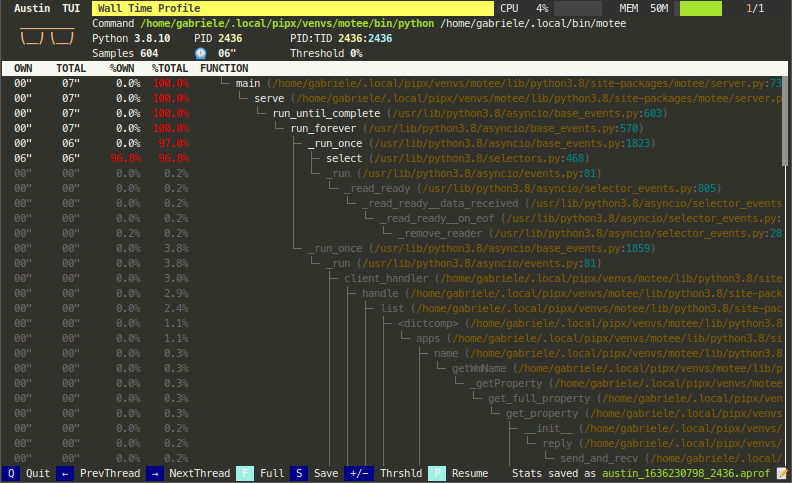
The simplest way to turn Austin into a full-fledged profiler is to use it together with the VS Code extension or combine it with FlameGraph or Speedscope. However, Austin's binary output can be piped into any other external or custom tools for further processing. Look, for instance, at the following Python TUI
Check out A Survey of Open-Source Python Profilers by Peter Norton for a general overview of Austin. The Ecosystem page has more tool ideas and examples.
Note
This documentation is published at https://p403n1x87.github.io/austin/, with one version for each Austin minor release. If you are browsing these files on GitHub, some elements, such as admonitions like this one, won't render as intended.
Why Austin
When there already are similar tools out there, it's normal to wonder why one should be interested in yet another one. So here is a list of features that currently distinguish Austin.
-
Written in pure C Austin is written in pure C code. There are no dependencies on third-party libraries except for the standard C library and the API provided by the Operating System.
-
Just a sampler Austin is just a frame stack sampler. It looks into a running Python application at regular intervals of time and dumps whatever frame stack it finds. The samples can then be analysed at a later time so that Austin can sample at rates higher than other non-C alternatives that perform some aggregations at run-time.
-
Compact output, powerful tools Austin uses the compact MOJO binary format, which can be easily parsed with the
austin-pythonpackage, or converted to other popular formats. You can then go and build your own tool to analyse Austin's output. You could even make a player that replays the application execution in slow motion, so that you can see what has happened in temporal order. -
Small size Austin compiles to a single binary executable of just a bunch of KB.
-
Easy to maintain Occasionally, the Python C API changes and Austin will need to be adjusted to new releases. However, given that Austin, like CPython, is written in C, implementing the new changes is rather straight-forward.
Sampling Accuracy
Austin can sample stacks very rapidly, guaranteeing high accuracy, as well as allowing to reach very high sampling rates, if required. This makes Austin suitable for profiling applications in production with almost no compromise between accuracy and performance.
The rate of samples that cannot be collected depends on the workload: it is generally low, but it can be higher for applications whose stacks change very rapidly, e.g. with many short calls or deep recursion. See the Logging page for how to find the sampling statistics of a run.
Support Austin
Austin is a free and open-source project. A lot of effort goes into its development to ensure the best performance and that it stays up-to-date with the latest Python releases. If you find it useful, consider sponsoring this project, or have a look at the contributing guidelines if you want to help with the development.